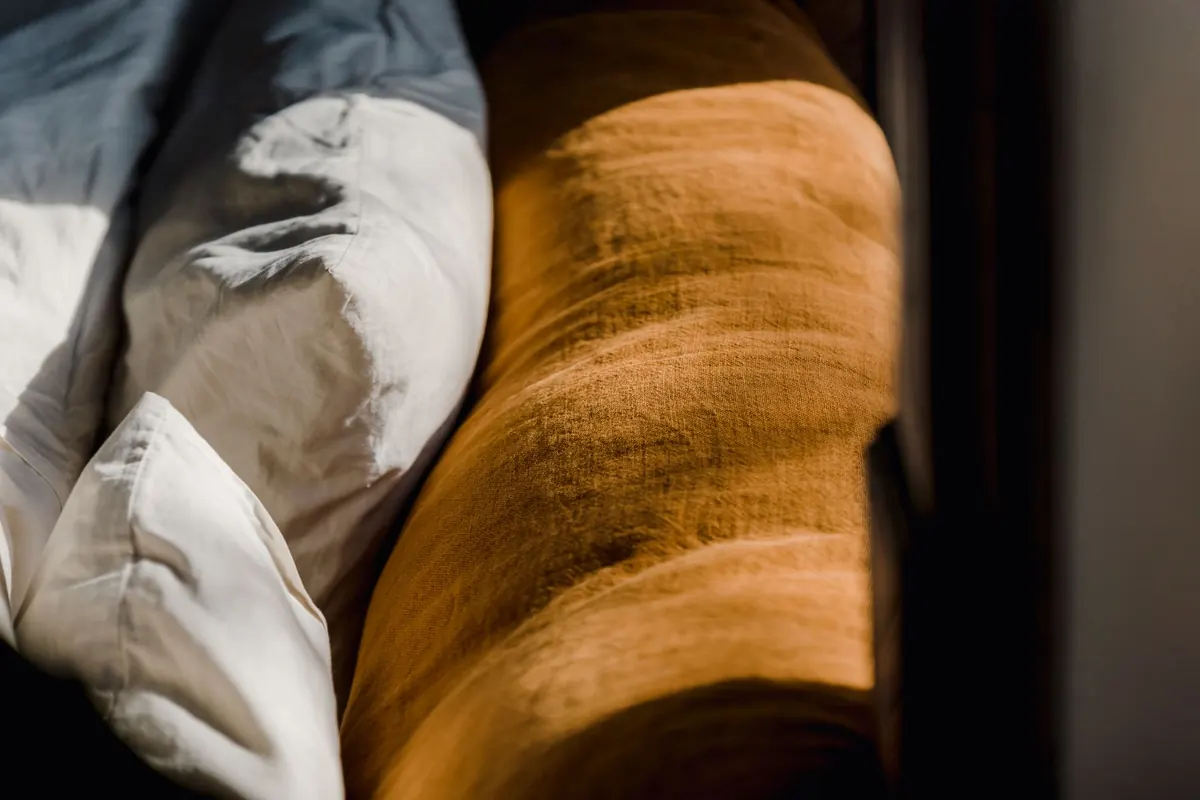
How to Layer Barn-Style Textiles in a Small City Apartment
A barn interior works because it has room to breathe: wide floorboards, tall ceilings, light falling through big doors. Move that look into a fourth-floor flat with one good window and the same textures can turn on you. Three chunky throws, a jute rug and a plaid blanket later, the room feels less like a farmhouse and more like a storage cupboard. The fix is not to buy less texture. It is to control two things — scale and color — and then layer in a deliberate order.
Measure the Room Before You Measure the Sofa
Most small-apartment textile mistakes are scale mistakes. A 4x6 rug floating in the middle of a living room makes the floor look smaller, not bigger, because the eye reads the gap of bare floor around it as the room's true size. A throw blanket sized for a king bed overwhelms a two-seat sofa. A cushion cover in a giant check eats a narrow armchair.
So start with numbers. Measure the longest wall in the room, the width of the floor between the baseboards, and the seat depth of your sofa or chair. Write them down and keep the note on your phone while you shop. As a working rule, one large textile beats three medium ones in any room under about 40 square metres. A single generous rug, a single heavy throw folded in half, and linen at the window will do more for the space than a collection of small pieces scattered around it.
Height matters too. In a low-ceilinged room, keep the visual weight near the floor: a substantial rug, a low basket of blankets, cushions that sit rather than stack. In a room with good ceiling height and a tall window, you can carry texture upward with full-length linen curtains.
Choose Three Colors, Then Stop
Barn-style interiors are not really beige. They are a narrow range of undyed, weathered, workwear colors: oatmeal, flax, raw linen grey, faded charcoal, denim and ink blue, brick and rust, moss green. The look reads calm because the palette is small, not because the textures are dull.
Pick three: a dominant neutral for roughly two-thirds of the textiles, a mid-tone for a third, and one accent used sparingly. For example, oatmeal walls and rug, charcoal wool throw, and one faded indigo cushion. Or flax linen curtains, warm grey wool, and a rust-striped runner.
Two cautions for compact rooms. First, beware of stacking too many warm neutrals in a north-facing flat — cream on cream on cream can go flat and slightly dingy without daylight to lift it. Add a cooler grey or a deep blue for contrast. Second, keep the accent to one or two pieces. When a small room has four competing accent colors, the eye has nowhere to rest, and the space feels busier than it is.
Rugs: The Anchor Layer
The rug is the foundation of the whole scheme. Get it right and everything else can be lighter and cheaper. Get it wrong and no amount of nice cushions will rescue the room.
- Choose the largest rug the floor plan allows, not the largest that fits in the shop's standard sizes. In a living area, aim for the rug to reach under the front legs of every seat; in a dining nook, it should extend at least 60 cm past the table on all sides so chairs stay on it when pulled out.
- Lay a flat, tight-weave base — jute, sisal, or a cotton flatweave — and put a softer wool or wool-blend rug on top, offset slightly so both edges show. This gives you the layered barn look while keeping depth low enough for doors and chairs.
- Keep the top rug smaller than the base by a clear margin, and let the top rug carry any pattern. Two patterned rugs stacked together rarely work.
- Use a thin anti-slip pad under the top layer. On a smooth floor, a lightweight wool rug will creep; a pad stops it and adds a little softness underfoot.
In a studio or one-room flat, one big rug can define the sitting zone without a single wall or screen. That is often the cheapest way to make an open room feel planned.
Linen: The Light Layer
Linen does the job that heavy wool cannot: it softens a window or a sofa without adding visual weight. That makes it the most useful textile in a small apartment.
Use it at the window first. Unlined linen curtains hung close to the ceiling and just brushing the floor will make a low room feel taller and a narrow window feel wider. A relaxed, slightly crushed linen is right for this look; a stiff, shiny one is not.
Then use linen on seating. A loose linen slipcover over a plain sofa hides a lot and reads instantly barn-like. Linen cushion covers in the same or a neighbouring tone, in a mix of plain, ticking stripe and a small check, give texture without color noise. Keep pattern scale small here — thin stripes and narrow checks — because cushions are small objects and a big pattern will look like it belongs to a different room.
One practical note: linen wrinkles, and that is part of its character. Wash it cool, shake it out, and hang it damp. If you want a crisper finish, iron the curtains and leave the cushions alone.
Wool and Throws: The Warm Layer
Wool is where the rustic character actually lands — the sheepskin, the cable knit, the scratchy blanket from a market. But wool is bulky, and bulk is what small rooms cannot absorb. So keep the count low and the placement deliberate.
- One throw per seat. Not two, not a pile. Fold it in thirds lengthwise and drape it over an arm or the back, not the whole sofa.
- Go chunky on the floor, fine on the furniture. A heavy knit or sheepskin on a footstool or bench reads generous; a thick knit over a slim armchair reads lumpy.
- Store the off-season ones. A lidded basket or a fabric box under the bed holds the winter wool in summer and keeps the room visually quiet.
- Contrast the weight, not the color. A fine linen cushion next to a heavy wool throw looks intentional. A heavy wool cushion next to a heavy wool throw looks like a stack of laundry.
Keep Pattern to Two Scales
Barn textiles come with a lot of pattern built in: grain-sack stripes, ticking, windowpane checks, simple plaids. In a small room, limit yourself to two pattern scales — one large and one small — and repeat each at least twice so the eye recognises them as a decision rather than an accident. A wide stripe on a runner plus fine ticking on cushions is enough. Adding a plaid blanket and a printed tea towel and a patterned rug turns a considered room into a jumble.
Edit, Rotate, and Leave Space
Layering is not a one-off. Twice a year — when the heating goes on and when it goes off — take everything off the sofa and out of the basket, and put back only what the room needs for the coming season. Winter: wool throw, heavier rug on top, a sheepskin on the bench. Summer: linen slipcover, cotton flatweave, the wool folded away. Rotating keeps textiles cleaner and stops the room from becoming a place where fabric accumulates by default.
Then leave something bare. Bare floorboards at the edge of the rug, a plain painted wall, an uncovered chair seat. The barn look depends on contrast between texture and emptiness; without the emptiness, all that wool and linen has nothing to work against. In a small apartment, that restraint is what makes a layered room feel warm rather than full.
Photo: Tim Samuel / Pexels